Philosophy, Religion & Spirituality
Hanuman: The Strength to Serve
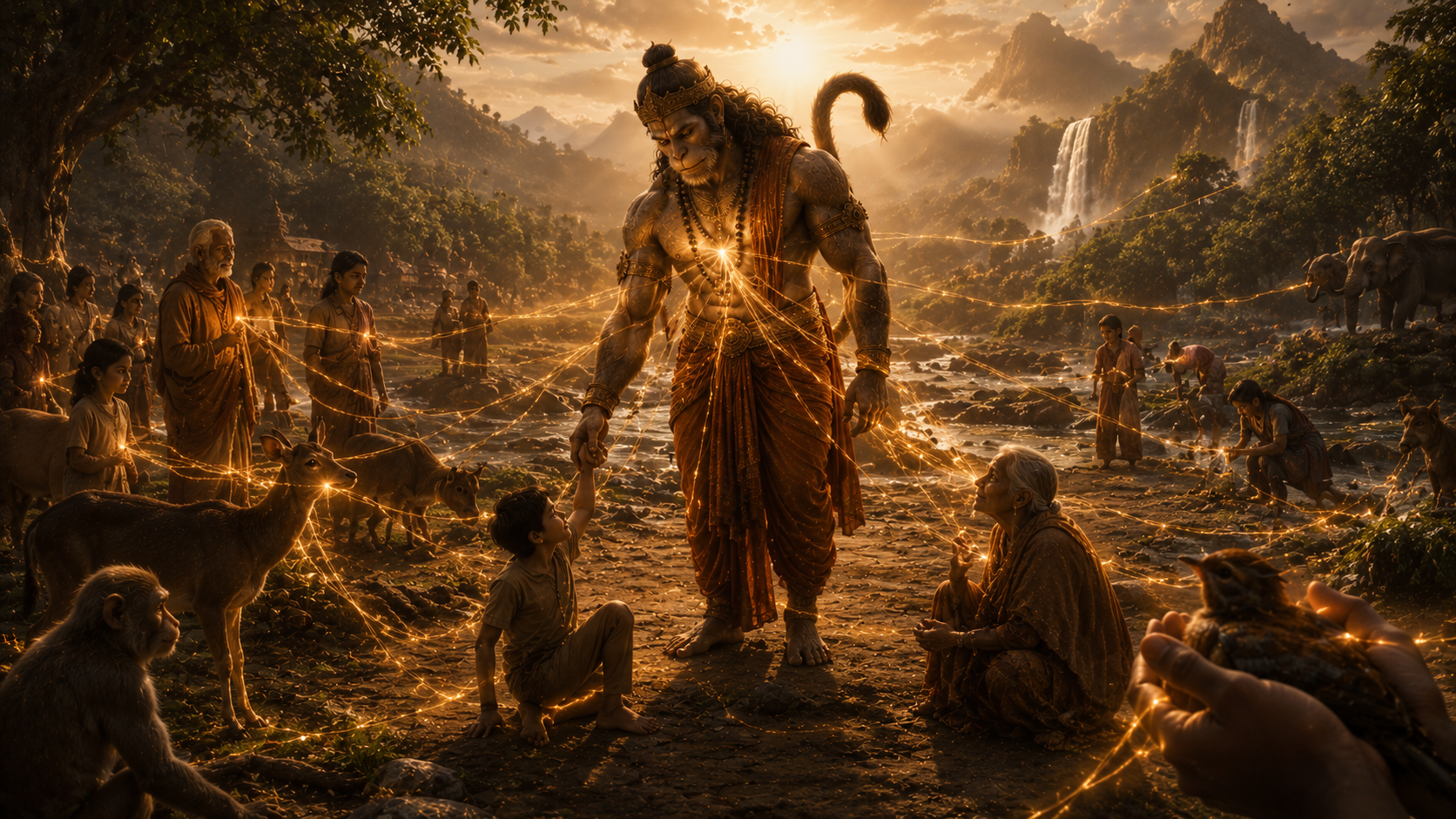
Hanuman represents a form of strength guided by humility, devotion, and service. His story invites us to look beyond power and ambition and ask a more important question: what are our abilities ultimately serving?
We often imagine strength as the ability to impose our will on the world. The strongest person, we assume, is the one who needs no one, fears nothing, and answers to nobody.
Hanuman represents a very different kind of strength.
In the Ramayana, he possesses extraordinary power. He can cross an ocean in a single leap, change his size, confront armies, and carry a mountain when the life of Lakshmana is at stake. Yet none of these abilities is what makes Hanuman remarkable. Power, by itself, is common in mythology. What distinguishes Hanuman is what he does with it.
He places it in service of something greater than himself.
Hanuman does not seek a kingdom, recognition, or authority. He does not use his strength to prove that he is stronger than everyone around him. His identity is rooted in devotion to Rama and commitment to Rama’s purpose. Again and again, he acts not for personal glory but because something needs to be done.
That is why Hanuman’s humility should not be confused with weakness or submission. His devotion does not make him passive. It gives his power direction. When the moment demands courage, he is courageous. When it demands intelligence, restraint, or diplomacy, he responds accordingly. When decisive action becomes necessary, few figures in the epic are more formidable.
There is a lesson here for a culture that often treats ambition as an end in itself. We are encouraged to become more capable, influential, and visible—but we spend far less time asking what our capabilities are for. Strength without purpose can become domination. Intelligence without principle can become manipulation. Ambition without service can leave us endlessly building a larger version of the self.
Hanuman offers another possibility: cultivate your abilities fully, but do not make yourself their ultimate purpose.
One of the most meaningful moments in his story comes before his leap across the ocean to Lanka. Faced with an apparently impossible distance, Hanuman initially does not step forward. It is only when Jambavan reminds him of his forgotten powers that he recognises what he is capable of and acts.
The episode is often read as a reminder that we possess strengths we have forgotten. But there is another detail worth noticing: Hanuman remembers his power when there is a reason to use it. His potential becomes visible in the presence of responsibility. Purpose does not merely benefit from strength; sometimes, it awakens it.
This may be why Hanuman remains such a compelling figure. He brings together qualities we often separate: strength and gentleness, confidence and humility, discipline and love. He neither denies his power nor worships it. He uses it.
Devotion, understood this way, is not simply religious belief. It is the act of arranging one’s life around something one considers worthy of service. That may be God, but it may also be truth, family, justice, community, or a responsibility that extends beyond personal comfort. The object matters, of course; devotion to an unworthy cause can be dangerous. But so can a life devoted to nothing beyond the self.
Hanuman therefore presents a demanding question: not whether we are powerful, talented, or successful, but what our power, talent, and success are serving.
Perhaps real strength is not the freedom to do whatever we want. Perhaps it is the discipline to become capable—and the humility to dedicate that capability to something greater than ourselves.