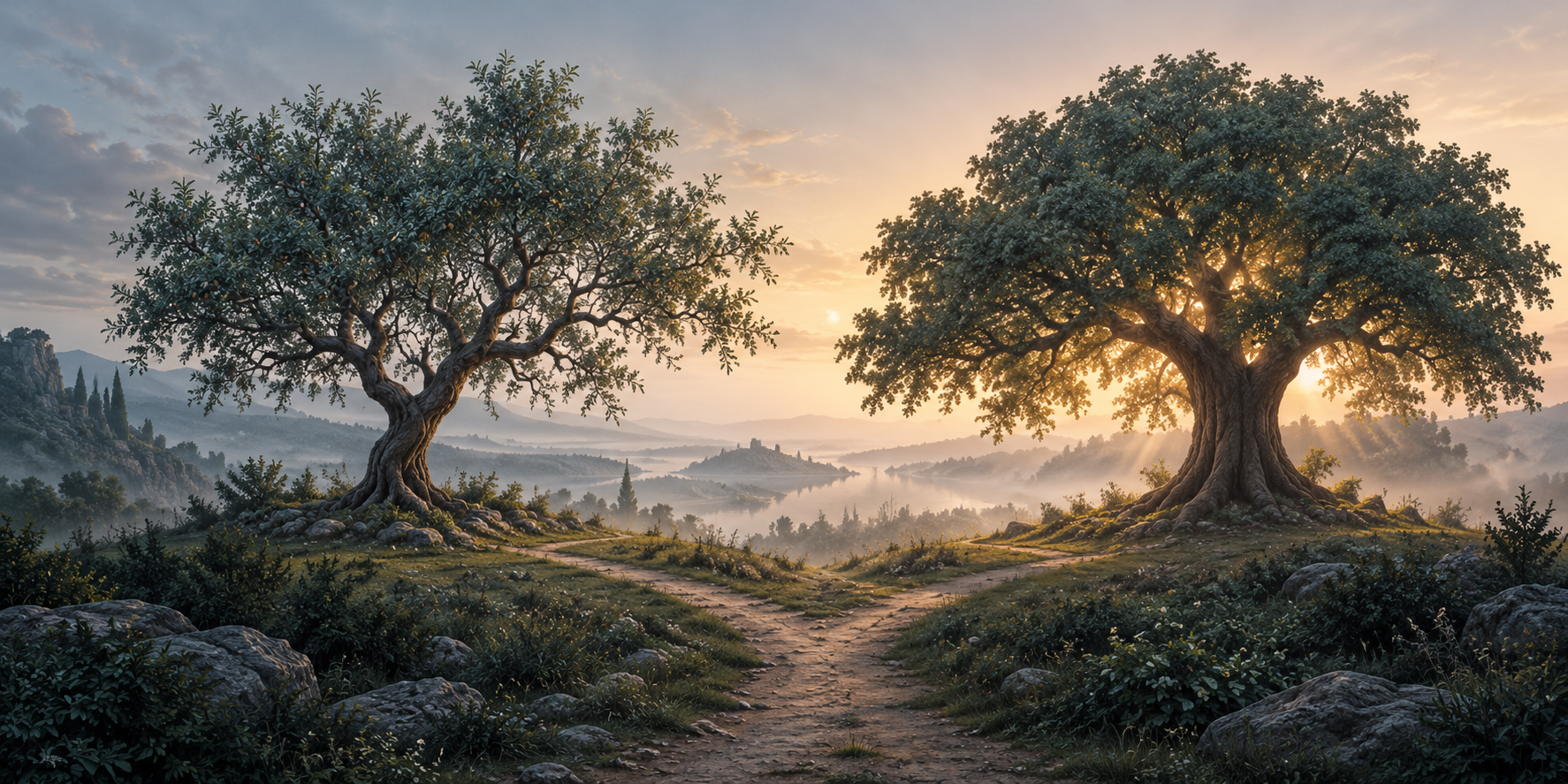
Between Eden and Moksha · The Genesis Arc
The Two Trees: Why Knowledge Was Not Enough
Through the two trees of Eden, this essay explores humanity’s movement from unconscious innocence into divided consciousness. In dialogue with Vedanta, samsara and moksha, it asks whether the spiritual journey is not a return to ignorance, but a path towards conscious union with the divine.
View the Between Eden and Moksha series →When I first read the story of Adam and Eve, one question stayed with me: Why would God place the Tree of Knowledge in the garden if eating from it would bring suffering, exile and death?
If the fruit was so dangerous, why allow it to exist at all?
The usual answer is that the tree made human freedom possible. Love and obedience would mean little if Adam and Eve had no alternative. But as I continued thinking about the story, another possibility began to emerge.
Perhaps Eden represents not only innocence, but unconscious innocence.
Adam and Eve live in the presence of God, but they have never known anything else. They have not experienced separation, shame or the divided mind. Their relationship with the divine is real, but it has not yet been consciously chosen after confronting an alternative. They are innocent because the possibility of being otherwise has not fully entered their awareness.
Before eating the fruit, they are described as naked and unashamed. They do not examine themselves through the eyes of another. They do not hide their bodies, defend their identities or compare themselves against an external standard. They simply exist.
After eating the fruit, the first thing they recognise is their nakedness.
They cover themselves and hide from God. When questioned, Adam blames Eve, and Eve blames the serpent. Openness becomes shame. Trust becomes fear. Partnership becomes accusation.
Something has changed, but it is not simply that they have become more intelligent.
Their experience of reality has become divided: good and evil, desirable and undesirable, self and other, innocence and guilt. They no longer participate in life without judgement. They now stand apart from themselves, observing, evaluating and defending who they are.
Seen symbolically, the fall can be understood as the awakening of the separate self.
This does not mean that knowledge itself is evil. The tree is not called the Tree of Knowledge generally, but the Tree of the Knowledge of Good and Evil. One interpretation is that humanity does not merely acquire moral awareness; it attempts to claim the authority to determine good and evil for itself.
The temptation is not simply to learn. It is to become “like God”—to stand at the centre of reality and judge it through a limited human perspective.
Knowledge expands, but wholeness contracts.
This reminded me of maya and avidya in Vedanta. The comparison is not exact. Genesis describes disobedience, sin and estrangement from God. Vedanta often describes bondage as arising from ignorance of our true nature and identification with the separate ego. Christianity and the Hindu philosophical traditions do not offer identical understandings of God, the self or liberation.
Yet both seem to recognise something familiar in the human condition: we experience ourselves as separate beings, trapped within judgement, desire, fear and attachment. The mind divides reality into what serves us and what threatens us, what elevates us and what diminishes us, what we want and what we wish to avoid.
We become conscious, but not necessarily awake.
This creates an apparent contradiction. Adam and Eve suffer after gaining knowledge, while Vedanta describes suffering as arising from ignorance. But perhaps the two ideas can still speak to one another.
We can possess enormous knowledge about the world while remaining ignorant of who we are.
We can understand how to build cities, cure diseases, organise societies and extend human life while knowing very little about how to live without fear, resentment or greed. We can become more informed without becoming more compassionate. We can expand the power of the mind while remaining governed by the ego.
Information is not wisdom. Self-consciousness is not self-knowledge.
Within Hindu traditions, human existence is often understood through samsara: the continuing cycle of birth, death and rebirth shaped by karma, desire and ignorance. Liberation, or moksha, is not simply another favourable life within that cycle. It is freedom from the condition that keeps the cycle turning.
Different Hindu traditions understand this liberation differently. Some speak of realising the deepest self’s unity with ultimate reality. Others emphasise loving communion with the divine while preserving a distinction between the individual soul and God. The paths may involve knowledge, devotion, disciplined action, meditation or divine grace.
What they share is the idea that liberation must become conscious. It is not merely the innocence of someone who has never encountered division. It is the freedom of someone who has encountered attachment, ego and suffering, yet turns deliberately towards the divine.
This gave me another way to read Eden.
Symbolically, each of us begins in a kind of unexamined innocence. We enter the world before we understand status, shame, success or failure. Gradually, we acquire identities and learn to divide the world. We learn who we are supposed to be, what we should possess, how others see us and where we stand in comparison with them.
We eat from the Tree of Knowledge again and again.
But spiritual life does not ask us to become unconscious once more. We cannot simply forget what we have seen or return to the innocence of a child. The journey is not backwards—from awareness into ignorance. It is forward, from unconscious innocence, through conscious separation, towards a conscious relationship with the divine.
This does not mean the fall was good or necessary. Nor does it mean Genesis secretly teaches karma or reincarnation. It means that the story can illuminate a distinction between innocence that has never confronted separation and union that is freely sought after experiencing it.
The second tree in Eden makes this journey even more significant.
After Adam and Eve eat from the forbidden tree, God prevents them from reaching the Tree of Life and living forever. At first, this appears to be another punishment. But what if it is also an act of mercy?
To live forever while trapped in shame, fear, blame and alienation would not be liberation. It would make the fractured condition permanent. Humanity has reached for knowledge but has not yet developed the wisdom to live eternally with what it now knows.
Exile may therefore be both consequence and protection. Humanity cannot remain in the garden as it was, but neither is it allowed to make its brokenness immortal.
The biblical story does not end with the Tree of Life lost forever. It reappears in the final chapter of Revelation, where it stands within a restored creation and its leaves are described as being “for the healing of the nations.”
The Bible begins with humanity beside the Tree of Life in untested innocence. It ends with humanity returning to the Tree of Life after a long history of freedom, failure, suffering and redemption.
It is not simply a return to the beginning. It is restoration with awareness.
Perhaps this is the deeper journey between Eden and moksha: not the recovery of an innocence that never knew separation, but the discovery of a union consciously entered after we have experienced what it means to live apart.
Humanity ate from the Tree of Knowledge.
The question is whether knowledge will remain a source of division—or become part of the wisdom that leads us back to life.