Between Eden and Moksha · The Genesis Arc
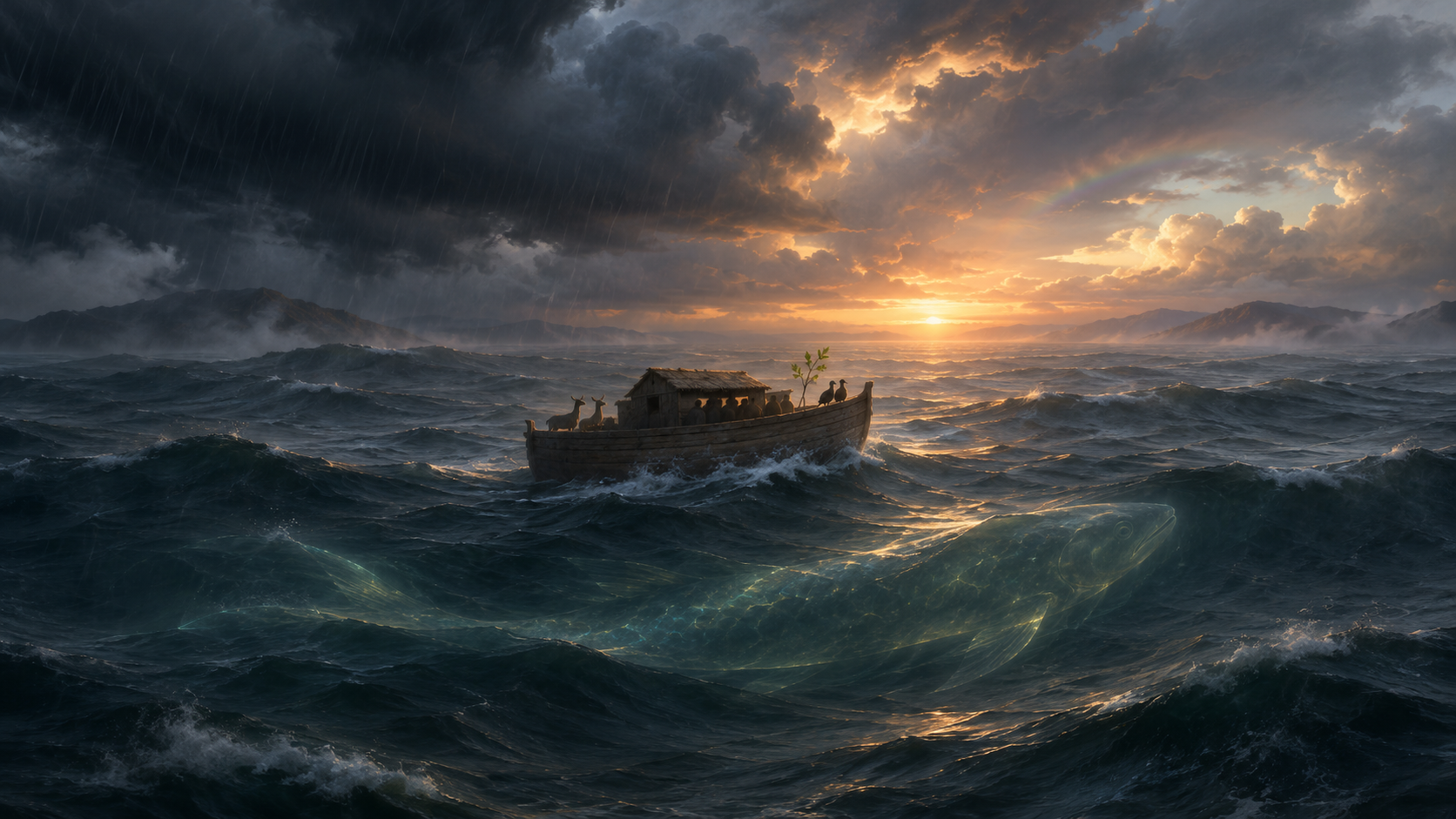
The Floods of Noah and Manu: Why Humanity Dreams of Beginning Again
The flood stories of Noah and Manu imagine the world overwhelmed by water and life preserved for a new beginning. Yet renewal is not the same as transformation. By placing these distinct traditions in conversation, this essay asks whether any external reset, personal, political, or cosmic, can resolve the deeper patterns that human beings carry into the world they rebuild.
View the Between Eden and Moksha series →Human beings are drawn to the promise of a clean beginning.
We imagine leaving a painful past behind, replacing a broken system, moving to another country, beginning a new relationship or rebuilding society under a different order. Civilizations express the same desire on a larger scale. When the world appears too corrupt to repair, the imagination turns towards destruction and renewal: sweep everything away, preserve what remains good and begin again.
Few images express this longing more powerfully than a flood.
Water is an ancient paradox. It sustains life, yet it can erase it. It cleanses, but it also overwhelms. A flood can therefore represent both death and rebirth, the dissolution of an old world and the possibility of another.
This symbolism appears in many cultures, but similarity does not make their stories identical. The biblical account of Noah and the Hindu traditions surrounding Manu and the fish emerge from different textual histories and theological worlds. Placing them beside one another is valuable precisely because their resemblance reveals important differences.
In Genesis, the flood is preceded by a moral crisis. The earth has become corrupt and filled with violence. The problem is not merely that individuals have made isolated mistakes; violence has become the condition of the world they inhabit. God resolves to bring judgement upon this order, while preserving Noah, his family and representatives of animal life in the ark.
Noah survives because he is described as righteous and because he responds to the diving warning with obedience. The ark becomes a vessel through which creation passes from one world into another. When the waters recede, Noah steps onto the earth as the ancestor of a renewed humanity.
The story seems to fulfil the dream of beginning again. Yet Genesis immediately complicates that dream.
After the flood, God acknowledges that the inclination of the human heart remains troubled. The waters have removed a violent generation, but they have not removed the human capacity for violence. Noah himself soon appears not as an idealised saviour, but as a vulnerable and imperfect man. The world has been washed, yet the human heart has not simply been remade.
This makes the covenant after the flood especially significant. God places the bow in the clouds and promises never again to destroy all life by flood. The covenant is not proof that humanity has become perfect. It is a divine commitment to remain in relationship with an imperfect creation. The new beginning rests not on human purity, but on restraint, mercy and responsibility within a world where moral failure remains possible.
The story of Manu begins from a different moral setting.
In the early account found in the Śatapatha Brāhmaṇa, a small fish asks Manu for protection. Larger fish consume smaller ones, and the creature appeals to Manu to save it. He cares for the fish as it grows, moving it from a jar to a pond and eventually to the sea. In return, the fish warns Manu of a coming flood and instructs him to build a vessel. When the waters arrive, the fish guides the vessel to safety, preserving Manu through the dissolution.
There is a striking moral symmetry here: the being Manu protects becomes the being that preserves him. Care for vulnerable life is not incidental to the story; it initiates the relationship through which the future is saved.
The tradition develops across later Hindu texts. The fish becomes associated explicitly with Matsya, the fish incarnation of Vishnu, and the narrative expands to include sages, seeds and sacred knowledge. The flood takes its place within a vision of cosmic cycles, in which worlds arise, dissolve and arise again.
This is not the same narrative logic as Genesis. The earliest Manu account does not present the flood primarily as punishment for universal human wickedness, while the later Matsya tradition is concerned with the preservation of life, wisdom and cosmic order through a period of dissolution.
The parallels remain compelling. A chosen person receives a warning. A vessel preserves life. The waters rise and recede. A new human beginning becomes possible. But the ethical emphases differ. Noah is distinguished by righteousness and obedience in a world of violence. Manu first responds with protection towards a vulnerable creature. In Genesis, the conclusion is a covenant between God, humanity and the living world. In the Manu traditions, survival belongs to a larger pattern of cosmic preservation and renewal.
Neither story, however, should be confused with liberation.
In many Hindu traditions, moksha means freedom from samsara, the cycle of birth, death and rebirth. Cosmic renewal is not yet moksha. A new world remains within the cycle, just as another birth remains within samsara. Creation may begin again, but beginning again is not the same as becoming free.
The biblical flood reveals a similar limit from another direction. Humanity receives a renewed earth, yet the moral condition of humanity remains unresolved. Noah carries human possibility into the new world, but he also carries human weakness. The flood changes the environment in which humanity lives; it does not complete the transformation of the humanity that lives within it.
This is why flood stories continue to speak to modern life. We repeatedly place our hope in external resets. We imagine that a new government will end corruption, a new technology will overcome human bias, a new economic system will eliminate exploitation or a new beginning in our personal lives will free us from old patterns.
Structural change can be necessary, and unjust systems should not be protected by appeals to personal morality. But new structures remain vulnerable when the people who inhabit them carry forward the same greed, fear, resentment and desire for domination.
We keep rebuilding the world while bringing the old self into it.
The recurring dream of the flood is therefore understandable. When repair feels impossible, erasure appears merciful. If only the past could be washed away, perhaps innocence could be recovered. But the stories of Noah and Manu suggest that survival is not enough. Something must be preserved—life, moral responsibility, sacred knowledge, compassion—but preservation must also lead towards transformation. Otherwise, the new world becomes another stage upon which the old patterns return.
A flood can renew the world. It cannot, by itself, transform the human being.
Perhaps the world does not need another flood. Perhaps it needs the transformation the flood could not accomplish: a renewal that does more than rearrange the world around us, because it also begins within us.